

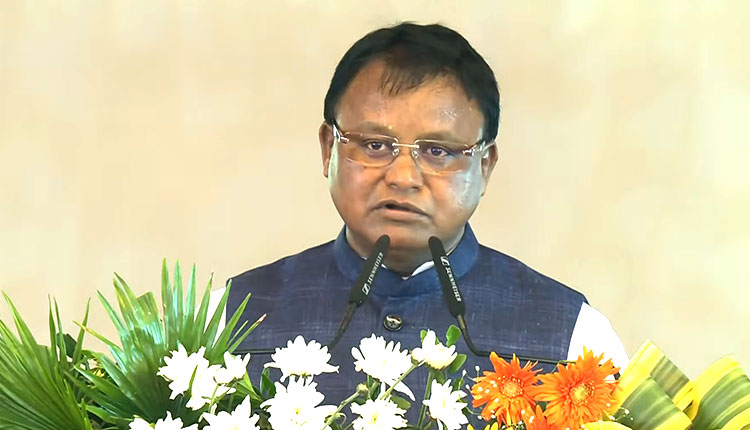
Rairangpur: Odisha Chief Minister Mohan Charan Majhi on Saturday highlighted his government’s achievements over the past two years, credited the Centre’s support for accelerating the state’s development, and expressed confidence that Odisha would emerge as a major employment hub in the coming years.
Addressing a public gathering in Rairangpur in the presence of President Droupadi Murmu and Prime Minister Narendra Modi, Majhi described the occasion as a “golden chapter” in Odisha’s history and congratulated President Murmu on her 68th birthday.
Praising the President’s journey from a tribal-dominated village in Mayurbhanj district to the country’s highest constitutional office, the Chief Minister said her life symbolises sacrifice, service, dedication and faith in India’s constitutional system, inspiring women across the nation.
Expressing gratitude to Prime Minister Modi for attending the event, Majhi noted that the Prime Minister had visited Odisha eight times since the formation of the BJP government in the state in June 2024. He said every visit had brought development initiatives and reflected the Centre’s commitment towards Odisha.
Highlighting the achievements of the state government, Majhi said several welfare programmes had been launched in the last two years, including Subhadra Yojana for women, Mukhyamantri Kanya Bibaha Yojana, Chief Minister’s Kanya Sumangal Yojana, Krushak Samriddhi Yojana for farmers, Godabarish Mishra Adarsha Primary School Yojana for students, Shree Jagannath Darshan Yojana for senior citizens and Ayushman Yojana for healthcare.
The Chief Minister said the state had also decided to provide free education from kindergarten to postgraduate level and implemented reservation for socially and educationally backward classes across general, medical and technical education streams.
Emphasising industrial growth, Majhi said the industrial momentum generated through the “Utkarsh Odisha – Make in Odisha” initiative had expanded significantly. He stated that 152 industrial projects worth ₹3.11 lakh crore had been inaugurated or had their foundation stones laid so far, with the potential to generate employment for nearly 2.5 lakh people. He added that more than 44,000 government jobs had been provided during the period.
According to the Chief Minister, industries are now being established in 29 of Odisha’s 30 districts, making industrialisation an inclusive process. He expressed confidence that Odisha would eventually witness reverse migration, with people from other states coming to Odisha for employment opportunities instead of Odias migrating elsewhere.
Majhi also highlighted major investments and infrastructure projects secured under what he termed the “double-engine government.” He said Odisha had received railway projects worth ₹90,000 crore, road projects worth ₹40,000 crore, port projects worth ₹25,000 crore, shipbuilding and repair cluster projects worth ₹25,000 crore, and a petrochemical project worth ₹80,000 crore at Paradip. He further referred to the ₹5,000-crore Bhubaneswar-Cuttack-Puri-Paradip Economic Corridor and said projects worth ₹50,000 crore inaugurated on Saturday reflected the scale of development underway in the state.
Reviewing his government’s performance, Majhi said significant progress had been achieved in education, healthcare, women’s empowerment, livelihood generation and industrial development. He asserted that Odisha had emerged as a preferred destination for investors due to its industry-friendly policies.
Reaffirming his government’s commitment to public welfare, the Chief Minister said Odisha would continue working towards the goal of a “Samruddha Odisha” by 2036 while contributing to the national vision of a Viksit India by 2047.
Referring to Prime Minister Modi’s recent participation in the G-7 Summit, Majhi said India’s growing global stature reflected the country’s transformation over the past twelve years and underscored its increasing influence on the world stage. He said Odisha would continue to move forward under the Prime Minister’s guidance to realise the shared vision of a developed state and a developed nation.
